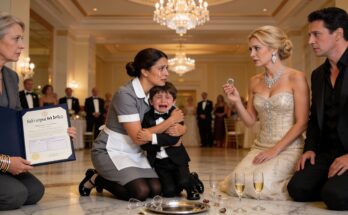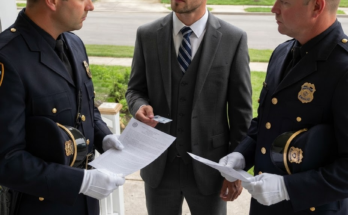
The housekeeper walked into my husband’s funeral carrying an axe and screamed:
“STOP THE FUNERAL—ROBERT HAYES IS NOT IN THAT COFFIN!”
My name is Eleanor Hayes.
For three days, I believed my husband had died after a sudden neurological emergency.
Robert was sixty-seven years old and the founder of Hayes Development Group, a major Virginia property company.
He had suffered a mild stroke the previous year but recovered well enough to return to work.
Maria Santos, his longtime caregiver, helped him through rehabilitation.
She organized his medication, drove him to therapy, and practiced emergency phone numbers with him until he could remember them without assistance.
Our son Ethan resented how quickly Robert returned to the company.
Ethan was thirty-two and believed his father refused to give him enough authority.
Their disagreements became louder during the final months.
Robert accused Ethan and company chief operating officer Daniel Mercer of hiding losses.
Ethan accused Robert of refusing to modernize the business.
I believed it was an ordinary conflict between a demanding father and an impatient son.
Then Robert disappeared.
Ethan told me his father collapsed during a private medical consultation.
He said Robert was transferred to a specialist facility and never regained consciousness.
The hospital would not discuss details with me because Ethan had become the emergency contact during Robert’s earlier stroke.
A physician called and said Robert had died.
Ethan arranged everything afterward.
He selected the funeral home, chose a closed coffin, and insisted the burial happen quickly.
He said Robert’s condition had altered his appearance.
I asked to see my husband once.
Ethan said it would be cruel.
I accepted that explanation because grief made every decision feel impossible.
At the funeral, the glossy white coffin stood beneath large arrangements of white roses.
Friends, executives, and relatives filled the chapel.
Maria helped the service staff prepare the reception.
She wore her orange uniform and white apron.
Minutes before the service began, she received a call from an unfamiliar number.
Robert was on the other end.
His voice was weak.
He said he was alive inside a private clinic under another name.
He told Maria the coffin was empty and begged her to stop the burial.
Maria ran to the funeral director.
He refused to open the sealed coffin without Ethan’s authorization.
The chapel maintenance cabinet contained an emergency rescue axe.
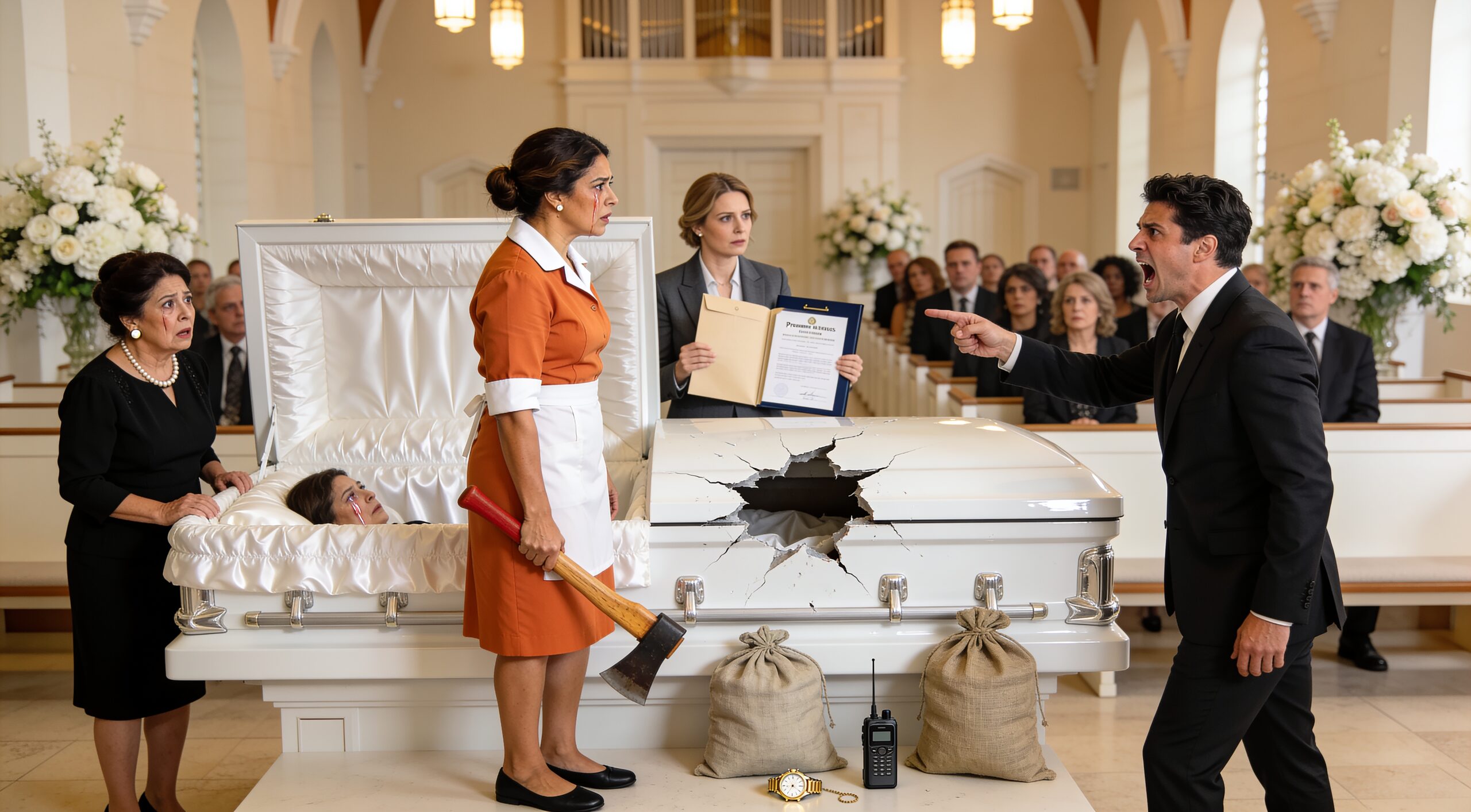
Maria picked it up and walked into the service.
She screamed that Robert was not inside the coffin.
Ethan ordered her to put down the axe and said she was fired.
Maria shouted that Robert had called her ten minutes earlier.
Ethan claimed grief had made her unstable.
Maria swung once into the empty center section of the lid.
The white wood cracked.
Guests screamed and moved away.
She pushed the broken panel aside.
There was no body.
Inside were two weighted canvas bags, white satin lining, Robert’s gold watch, and a small recorder.
I looked at Ethan and asked where my husband was.
Maria’s phone rang.
She answered on speaker.
Robert said:
“Eleanor, I’m alive—and Ethan knows where they took me.”
Ethan screamed for her to turn off the call.
Our attorney Rebecca Cole entered carrying documents Robert had arranged to send before he vanished.
Maria found a hospital bracelet inside the coffin.
It showed Robert had been discharged alive the previous day.
Rebecca revealed that the death certificate had been filed forty-eight hours before Robert disappeared.
Ethan had signed the funeral authorization before anyone officially told me Robert was dead.
He claimed the hospital said his father was brain-dead.
The real records did not support that statement.
Rebecca then explained why the burial mattered.
Robert’s company trust contained an emergency succession clause.
If his death and burial were legally confirmed, Ethan would receive immediate control of forty-two million dollars in company shares.
The burial was scheduled for noon.
The transfer would activate one minute later.
Maria lifted one weighted bag.
Beneath it was Robert’s gold watch and the hidden recorder.
The recorder captured Ethan saying:
“Once the coffin is sealed, no one can ask to see him.”
That sentence ended any possibility that the empty coffin was an innocent mistake.
Detective Marcus Hill moved the family into a private lounge.
Robert appeared on a live video call from a protected clinic.
A nurse had recognized him from the news and contacted the authorities.
Robert looked pale and exhausted.
He said Ethan arranged for him to be sedated and transferred under the false name Michael Lane.
Clinic employees were told he had advanced dementia.
He repeatedly gave them his real identity.
They dismissed his statements as confusion.
Ethan shouted that he had saved Robert’s life.
Robert shouted back:
“You hid me until my burial could transfer my shares!”
I screamed that Ethan had allowed me to kiss an empty coffin.
Ethan blamed Daniel Mercer.
He claimed Daniel believed the company would collapse if Robert regained control.
Rebecca displayed one-way airline tickets for Ethan and Daniel.
They planned to leave for London three hours after the funeral.
Robert then revealed that he had signed an emergency order removing Ethan from the company before he was sedated.
The order activated the moment Rebecca confirmed he was alive.
Ethan’s anger changed into panic.
He pointed at Maria and said she had ruined everything.
Detective Hill answered that the empty coffin had ruined everything.
Investigators searched Ethan’s executive office that afternoon.
A concealed wall safe contained sedation orders, two passports, false clinic records, a forged cremation authorization, and a black flash drive.
The cremation authorization allowed Ethan to destroy the empty coffin immediately after burial.
Once it was cremated, no one could demand that it be reopened.
The safe also contained bank records showing eighteen-point-four million dollars missing from Hayes Development.
Some funds had covered project losses.
Others paid Daniel’s shell companies, Dr. Stephen Ward, the private clinic, and personal property accounts.
Two-point-eight million dollars passed through an account opened in my name.
I had never created it.
The application used a copy of my passport, my Social Security information, and a forged signature.
Ethan claimed the account proved I helped him.
The evidence proved the opposite.
The account was designed to frame me if the fraud was discovered.
Investigators traced my identification documents to the Hayes family office.
Robert’s executive assistant, Julia Lane, admitted giving copies to Ethan.
He said the company needed them for a family-trust audit.
Julia had questioned one transfer.
Daniel falsely told her I approved it verbally.
She never received written confirmation.
Julia cooperated with investigators.
She was not part of the funeral plan, but she lost her position for releasing private records without proper authorization.
Robert explained how the conspiracy began.
He discovered that Ethan and Daniel had hidden serious losses inside company construction projects.
They used false invoices and related property firms to conceal debt from lenders.
Robert scheduled an emergency board meeting.
Two nights before that meeting, Ethan invited him to dinner.
Dr. Ward attended and told Robert he required an injection to prevent another stroke.
The injection was a powerful sedative.
Robert woke inside the private clinic without identification.
His chart described him as an unidentified patient with dementia.
A night nurse named Angela Brooks noticed that his face matched the billionaire whose funeral appeared on local news.
She reviewed his condition and realized he was conscious, oriented, and being kept under a false identity.
Angela gave him a phone.
Robert remembered Maria’s number.
That call stopped the burial.
Angela also preserved handwritten notes showing Robert’s true condition.
The official clinic file claimed severe incapacity.
Her notes proved he could communicate and make decisions.
Dr. Ward received six hundred thousand dollars through a company controlled by Daniel.
He claimed Ethan told him Robert was dangerous and required involuntary care.
Messages showed he knew Robert’s identity and understood the financial purpose of the delay.
Dr. Ward was arrested.
At Ethan’s office, Detective Hill played the black flash drive.
Recorded security audio captured Daniel saying:
“Keep Robert unconscious until the burial papers clear.”
Daniel claimed the recording had been edited.
Digital analysis confirmed it was authentic.
Daniel blamed Ethan for signing every transfer.
Ethan blamed Daniel for creating false invoices and selecting the clinic.
Each man had expected the other to remain silent.
The evidence turned them against one another within hours.
The final ledger page showed a transfer into the forged account carrying my name.
That was not the only attempt to frame an innocent person.
Investigators found an unsigned amendment to Robert’s trust.
It named Maria Santos as the beneficiary who would receive control if Robert and Ethan were removed.
Maria had never seen it.
Robert had never authorized it.
The forged amendment was intended to make Maria appear responsible if she exposed the empty coffin or questioned Robert’s disappearance.
The folder contained fingerprints belonging to Julia Lane.
At first, that discovery made her appear involved.
Julia explained that Ethan had asked her to organize a set of trust drafts weeks earlier.
She remembered seeing Maria’s name but assumed Robert intended to reward a longtime employee.
Security footage showed Julia delivered the folder to Ethan’s office and never opened it again.
The actual forgery was created on Daniel’s computer.
Daniel had used Julia’s routine handling of the folder to place her fingerprints on it.
He planned to frame both Maria and Julia if the conspiracy collapsed.
The strategy failed because the digital file retained his user credentials.
The board froze every disputed account.
Robert’s emergency order removed Ethan and Daniel from company leadership.
Independent auditors traced the missing eighteen-point-four million dollars.
Properties, investment accounts, and insurance payments were frozen.
More than eighteen million was eventually recovered.
A smaller remaining amount became part of the restitution judgments.
Ethan, Daniel, and Dr. Ward faced criminal charges.
Ethan pleaded guilty to conspiracy, financial fraud, custodial interference, forgery, and offenses connected to Robert’s unlawful confinement.
Daniel pleaded guilty to conspiracy, money laundering, evidence fabrication, and financial fraud.
Dr. Ward pleaded guilty to falsifying medical records and participating in the unlawful confinement.
The private clinic lost its license after investigators found administrators accepted Daniel’s payments without verifying Robert’s identity or legal status.
Nurse Angela became the central medical witness.
Maria became the witness who physically proved the funeral was fraudulent.
The court did not celebrate the axe.
The judge stated clearly that destroying property could have created danger.
However, the funeral director confirmed Maria warned everyone, cleared the area, and struck only the empty center of the coffin after every formal request to open it had been refused.
The funeral company declined to pursue charges and admitted it had accepted suspicious authorization documents without independent verification.
Six months later, we stood outside the Richmond Federal Courthouse after sentencing.
Robert was recovering in a wheelchair.
He could walk short distances with therapy, but no one pretended recovery would be immediate.
Ethan was escorted through the courthouse doors.
He turned toward his father and shouted:
“I was trying to save the company you refused to modernize!”
Robert answered:
“You tried to bury me alive on paper.”
Daniel shouted that Ethan had promised he would never be charged.
Ethan screamed that Daniel created the clinic records.
I faced both men.
“You made a widow out of me while my husband was still breathing.”
Rebecca announced that Robert’s company control was restored, most of the stolen money had been recovered, and the account opened in my name was proven fraudulent.
Robert took Maria’s hand.
“She broke a coffin to give me my life back.”
Ethan called out to his father.
Robert looked at him and said:
“My son died the day he signed my death certificate.”
Then we turned away.
That sentence did not mean Robert stopped loving the child Ethan had once been.
It meant he no longer protected the adult who tried to erase him.
Our family did not return to normal.
Normal had included too much silence.
Robert resigned from daily company management and appointed an independent board.
No relative could move major funds without outside approval.
I received complete access to medical and financial records.
Maria was offered a senior family-care position, but she chose to leave domestic work.
The company funded her nursing education after she said Angela’s courage inspired her to enter patient advocacy.
Maria accepted only after the independent board confirmed the support was not payment for testimony.
Angela joined a statewide program protecting vulnerable patients from identity and guardianship fraud.
Julia found another job after completing privacy and compliance training.
She continued cooperating with restitution proceedings.
Robert and I visited the funeral chapel one year later.
The damaged coffin no longer existed.
The funeral company had removed it as evidence and later destroyed it with court permission.
We stood in the same aisle where Maria had shouted.
Robert asked whether I had truly believed he was inside.
“Yes,” I said.
He looked toward the place where the coffin had stood.
“That must have been the loneliest room in the world.”
It was.
But it was also the room where a woman everyone considered an employee refused to remain silent.
Ethan had a premature death certificate.
Daniel had false medical records.
Dr. Ward had a private clinic.
The funeral home had a sealed coffin.
Maria had one phone call, Robert’s remembered number, and the courage to demand that the coffin be opened.
When no one listened, she broke the lid.
The coffin was empty.
And the truth inside it was heavier than any body could have been.